

Talent Spotlight
Wendy Shimata
VP of Autonomous Systems at Varda Space
VP of Autonomous Systems at Varda Space
“I’ve always tried to be open to take on tedious and repetitive tasks that most people consider boring or don’t have an interest in to improve things. This has helped me build a reputation for not being afraid to do hard work.”
I've been interested in space most of my life. I was one of those kids asking to stay up late for StarGate SG-1. I was fascinated by exploration from a civilization standpoint, and in awe of how small we are here and how much is left to explore. Looking at it as a career, I first considered astronomy and realized I wanted something more interactive. Then astronaut, but I get motion sickness. So I thought, I'll send people to space. As a seventh grader it didn't occur to me that this meant engineering hardware and software. I just knew I wanted to be involved in sending people up, and to expand what we could do from the ground to make that happen.
That kept me STEM-focused through high school: physics, robotics teams, science, statewide math competitions. For undergrad I went to Cornell for Engineering Physics, which gave me a foundational skill set for learning how things fundamentally work. I chose Cornell for its hands-on program and its student research and project teams. I wanted a project with a tangible outcome, something I'd specifically built. I joined CUSat, part of the AFRL nanosat program, working GNC, software, and operations, and supported integration and test, flight dynamics and analysis, operations, and mission operations. That taught me a lot about the industry and about engineering hardware and software to work together.
I had a few good internships at Cornell, so after graduating in 2009 I was eager to start working. I considered grad school but wanted practical experience first, so I went to the GNC team at Boeing Satellite Systems. The group had been part of Hughes Aircraft before Boeing acquired it, so I was mentored by people who'd worked on satellite systems since the 1960s. It ran as a small business inside Boeing, with its own high bay and its own missions. As a new engineer I could absorb all the knowledge around me. I remember walking through the high bay, seeing the entire history of the satellites they'd built, and being genuinely inspired.
In spring 2010 I started a part-time master's at USC, chosen for its astronautics program and because many classes were taught by people in the industry. One of my professors was James Wertz, author of SMAD, the book I'd used as my satellite bible through college. Seeing him in the flesh and knowing I'd learn from him married my theoretical applied physics degree to the master's.
Varda Space
- present
I'm responsible for the technical leadership, direction and growth of the flight software, guidance navigation & control and mission operations teams responsible for our next generation vehicle’s autonomous systems and their on-orbit mission.
Varda Space
SpaceX
The Boeing Company
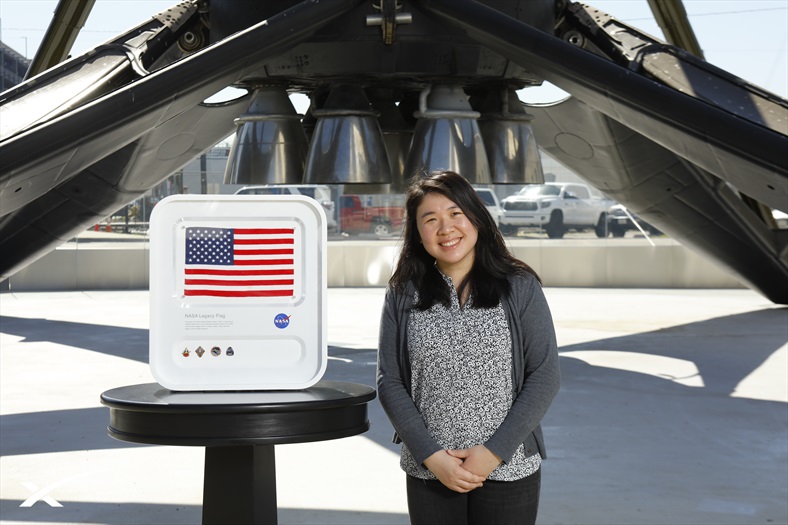
Wendy with the flag sent up to the ISS on the Demo-2 mission
I had a few good internships at Cornell, so after graduating in 2009 I was eager to start working. I considered grad school but wanted practical experience first, so I went to the GNC team at Boeing Satellite Systems. The group had been part of Hughes Aircraft before Boeing acquired it, so I was mentored by people who'd worked on satellite systems since the 1960s. It ran as a small business inside Boeing, with its own high bay and its own missions. As a new engineer I could absorb all the knowledge around me. I remember walking through the high bay, seeing the entire history of the satellites they'd built, and being genuinely inspired.
In spring 2010 I started a part-time master's at USC, chosen for its astronautics program and because many classes were taught by people in the industry. One of my professors was James Wertz, author of SMAD, the book I'd used as my satellite bible through college. Seeing him in the flesh and knowing I'd learn from him married my theoretical applied physics degree to the master's.
At the end of 2014, an old Cornell classmate at SpaceX told me they'd just signed the commercial crew contract, the new NASA partnership for manned flight with private companies as Shuttle retired. Both SpaceX and Boeing were awarded. Around the same time SpaceX had started flying Dragon 1 cargo resupply more regularly. They had a revolutionary way of thinking about flight avionics and their software stack, specifically state-of-the-art computing and processing, which makes the doors you can open feel unlimited. The design relied on a distributed network, teaching rockets and satellites to adjust if one node drops out from failure or radiation. I'd known SpaceX since the AFRL competition but had always seen it as a small, scrappy startup. The more I researched their progress by 2014, the more I realized they were becoming a legitimate organization.
About halfway through my time at SpaceX, in 2018, I became a manager and saw it as a chance to formalize my technical leadership. I'd never pursued direct reports or career management before, so I was surprised how much of the people side I enjoyed. Even as the role grew, it was immensely fulfilling to lead by example on what engineering culture and ownership should look like, to set that precedent and help people grow into the roles they were interested in.
At the end of 2021, after Inspiration-4, the first Dragon 2 freeflyer mission, I moved from the Dragon program to Starship to lead software for the Human Lander program. A few months later Will Bruey, an old SpaceX coworker, reached out about Varda. I wasn't looking for a new job, but given the recent transitions I was already thinking about new roles and teams, so making a transition was primed in my mind.
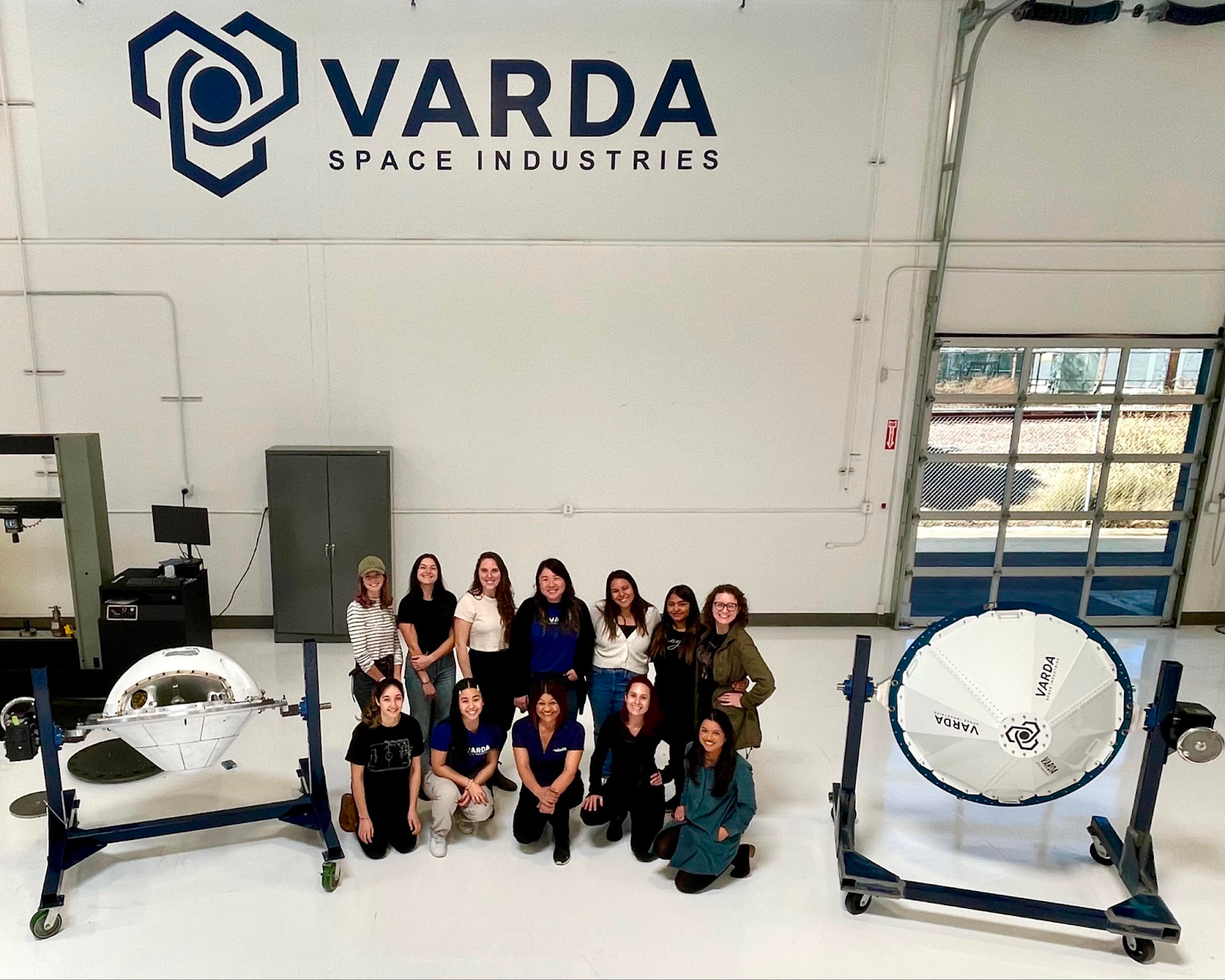
Varda on International Women’s Day
1
There is always room to grow as an engineer and as a leader.
2
It’s essential to be able to do the work directly.
3
Ability to dive into the core principles of engineering, leading by showing methodical investigation, being honest, solving problems, and working towards a solution.
4
Build cultures of responsibility, transparency, and openness
I’d have to say helping to fly the Dragon 2 Demo 2 mission while at SpaceX. I was the software lead for the program, and I had the opportunity to sit on-console as a flight software specialist during the launch in May 2020. I had the opportunity to work directly with Bob and Doug on several occasions for life support and crew capabilities software, so knowing that I’d help design and write a lot of the software gave the project breath (literally!) was a considerable accomplishment. Knowing how much hard work had gone into ensuring that all of the software worked as intended and sitting there in console mission control, watching Falcon take flight for the first time was incredibly surreal.
I’ve always tried to stay humble with my work and view us as a team. I believe there is no task too small to make something work. I’ve always been open to taking on tedious and repetitive tasks that most people consider boring or don’t have an interest in to improve things. This has helped me build a reputation for not being afraid to do hard work.
I had a great mentor at Cornell; he was the faculty advisor of the CUSat (Cornell University Satellite) program, a phenomenal engineer, and selected excellent coursework. The degree and hands-on experience really helped me formulate what was happening beyond the academic worldview of formulas and equations.
Space is inspiring. At Varda, at times it can be hard to understand if we are a pharmaceutical company, a space company, or a manufacturing company, but the truth is we’re doing all of this. We’re building a gravity-off machine that allows us to develop potentially life-saving medicine and that’s both wild and astonishing. This is what investing in space should be; it improves life here on Earth and beyond.
Stay curious! With so much information and education immediately available to learn and grow, everyone should utilize it. Just having access to the internet and online courses, Youtube education, hardware development kits, there is so much learning you can do on your own.
Join 50,000+ professionals already inside the space economy's most active network.