

Talent Spotlight
Daniel Meinzer
Head of RF at Northwood
Head of RF at Northwood
"I learned that effective management requires clear communication of what you value – and a keen awareness of your leadership and your team’s values."
My journey into engineering and space technology is rooted in a lifelong fascination with the unknown. As a child, I was captivated by the idea of space as the final frontier, a concept that was solidified when I had the chance to meet an astronaut in elementary school. I still have his autograph, and it serves as a reminder of what can be achieved. While I couldn’t work on space stuff at a young age, I spent a significant amount of time on game development and programming. This creative curiosity carried with me into high school, where I began experimenting with hobby electronics. I was that kid who learned programming in BASIC, not because I had to, but because it was fun.
I went to Michigan for its student-led engineering culture and ended up in an aerospace group building spacecraft hardware. CubeSats weren't accessible then, so we designed most subsystems ourselves: long nights soldering boards, troubleshooting designs, no academic credit. More formative than anything I did for a grade, and solving real problems next to my peers is where it set.
I joined SpaceX out of my master's, on the RF team just as it shifted from procuring communications hardware to building it in-house. Over eleven years I went from individual contributor to managing groups across hardware, FPGA, DSP, and RF systems, which shaped how I think about both engineering and leadership.
Then I wanted a smaller, faster team. At Northwood I lead RF for next-generation ground stations as a service, building data infrastructure for a satellite industry that keeps expanding.
Northwood
- present
SpaceX
SpaceX
SpaceX
SpaceX
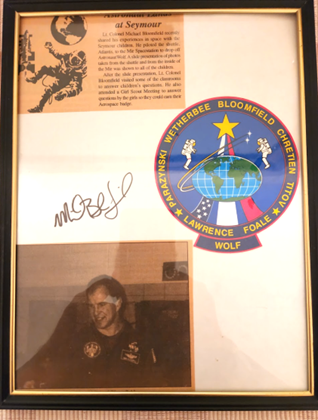
IMAGE: Signature and news article from astronaut Michael Bloomfield’s visit to Daniel Meinzer's elementary school.
Throughout my career, there have been several key decisions that have propelled me forward. The first critical step was during my time at the University of Michigan, where I made a conscious choice to immerse myself in extracurricular engineering projects. These weren’t just hobbies; they were real-world applications of the theories I was learning in the classroom. By dedicating my time to these projects, I gained practical experience that set me apart from my peers and gave me a deeper understanding of engineering principles.
In the professional world, the choice to prioritize learning and growth over other factors has been a consistent driver of my career progression. I’ve always sought out roles and projects that challenged me and allowed me to develop new skills. For instance, after my first internship at SpaceX, I realized that while it was a valuable experience, it didn’t give me the same freedom as working on research projects in school. The next summer I spent working on satellite hardware on Michigan, which I felt I could learn from even more - before returning to interview at SpaceX for a full time role after graduation. Every significant career move I’ve made has been guided by a desire to grow and learn.
The most impactful part of my education was not found in lectures or textbooks, but in the hands-on experience I gained through student projects. At Michigan, I was fortunate to be part of a community where students were encouraged to take on ambitious engineering challenges outside the classroom. Professor James W. Cutler’s Michigan Exploration Lab allowed me to build spacecraft hardware by hand - and gain experience you can’t fully grasp from theory alone—it required practical application, collaboration, and a lot of trial and error.
These projects taught me how to think like an engineer, to approach problems systematically, and to innovate when standard solutions weren’t available. I spent countless hours working on these projects, often during weekends or school breaks, because I was driven by a genuine interest in what we were doing. It wasn’t just about learning the technical skills; it was about developing the mindset to tackle complex unknowns.
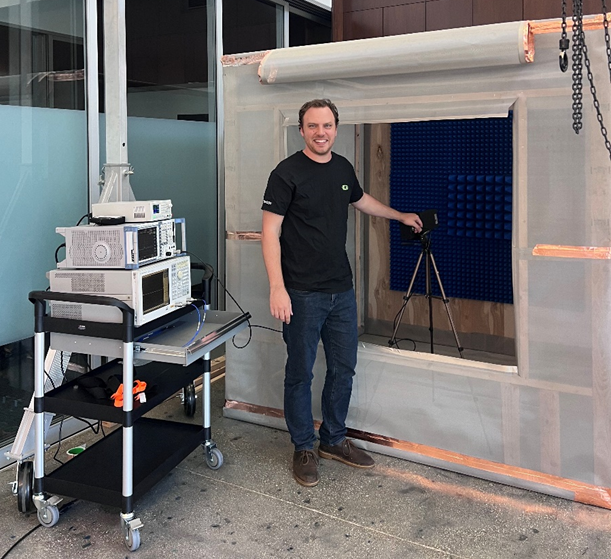
Scrappy RF chamber for antenna measurements at Northwood.
1
Rebuild from fundamentals. Break a concept to its base pieces (noise physics in RF, aperture area to antenna gain), then reassemble it yourself.
2
Chase the 10x. Working isn't finished. When a solution holds, ask what an order of magnitude better looks like.
3
Report the real timeline. Give candid schedule and risk assessments early, and know every detail of your own program cold.
4
Set goals and values, not solutions. Goals are measurable outcomes, values are how tradeoffs get weighed. The team finds the rest.
5
Make your values legible. Teams stall when they can't read what leadership values, or when it keeps moving.
The future of career opportunities, especially in the tech and space sectors, lies in solving the complex problems that are critical to the advancement of any industry. For instance, my current focus is on improving data infrastructure for satellites—a field that is becoming increasingly important as we rely more on satellite technology. The need for robust, reliable communication back to Earth is growing, and the solutions we develop now will have a lasting impact.
Don’t let yourself get jaded or resentful. When you buckle down, make a commitment to yourself that you are willing to accept the chance of a negative outcome from your investment - otherwise don’t do it. Once negativity sets in, it can be difficult to recover, so it’s essential to stay mindful of your emotional and mental well-being. Remember, the people you work with today have a very high chance of being your future collaborators, so maintaining good relationships and a healthy mindset is critical for a sustainable and fulfilling career.
Join 50,000+ professionals already inside the space economy's most active network.