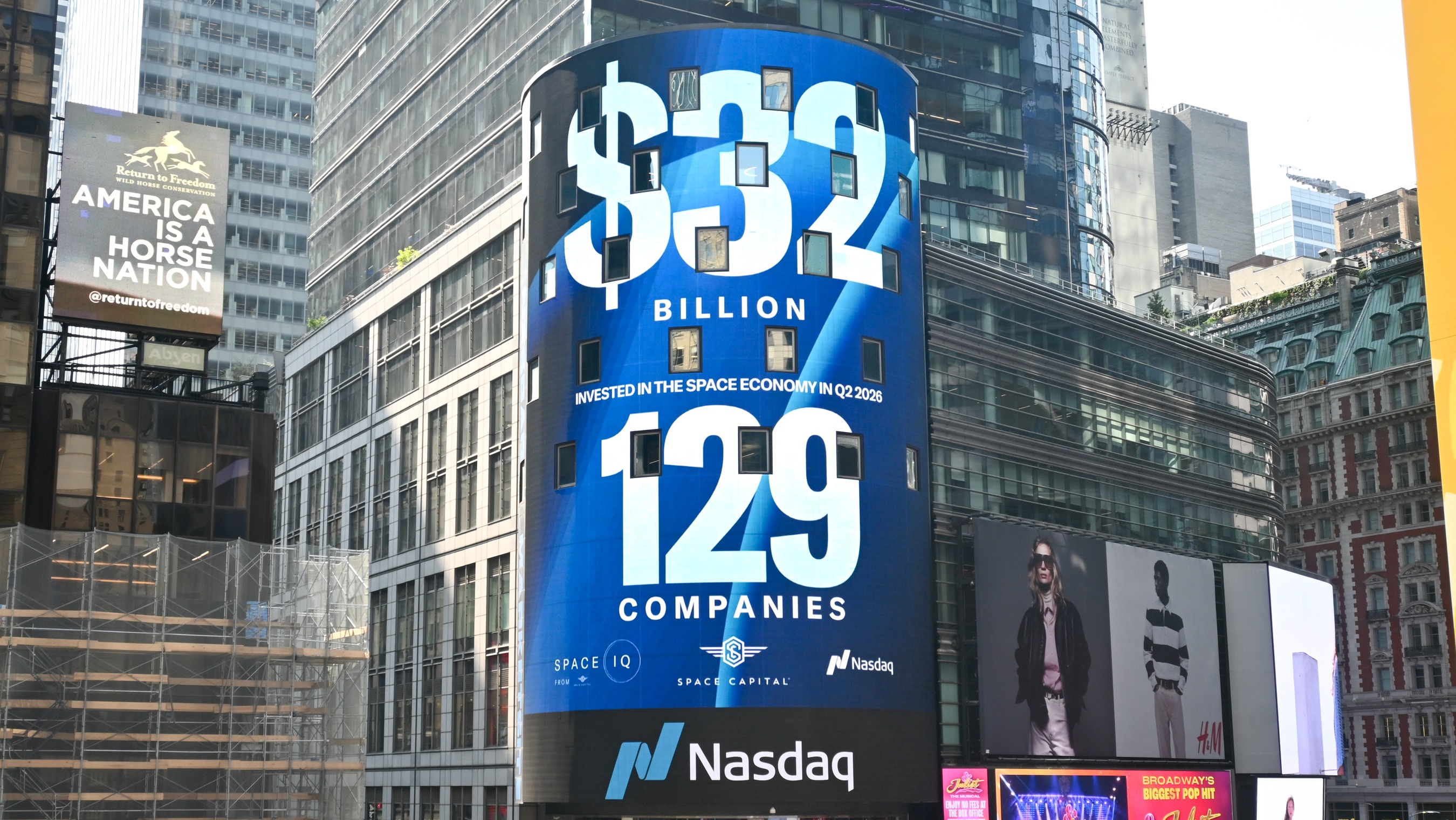
Last quarter we said the SpaceX IPO would force a reckoning among allocators. It happened faster than anyone expected: SPCX debuted on Nasdaq at north of $2 trillion, the largest IPO in history, and it listed as an AI company, not a rocket company. Here's what moved space capital markets.
The quarter opened with four astronauts returning from the Moon and closed with the largest IPO in history. In between, investors ran out of reasons to ignore the space economy. Three things defined Q2: SpaceX went public as an AI company, Rocket Lab showed where access to orbit leads, and the public markets finally opened for the space economy at scale.
The first AI IPO
SpaceX's S-1 does not describe a rocket company. It describes "the only company building the integrated hardware and software infrastructure of the future across space, connectivity, and AI." A launcher and satellite operator is how the world has understood SpaceX for two decades. The filing says the company has outgrown that description.
The market agreed. SpaceX debuted on Nasdaq under SPCX on June 12 and closed its first day up 19% at a market cap north of $2 trillion, making it one of the most valuable companies in the world.
Look at the sequence of moves: SpaceX merged with xAI ahead of the IPO. It bought an option to acquire Cursor, then exercised it in a $60 billion all-stock deal days after the debut. In one quarter it sold AI compute to Anthropic and Google for roughly $26 billion annualized, more than doubling the revenue it took 23 years to build. It will make AI chips with Terafab to power its orbital data centers. And it just launched a $25 billion notes offering, following big tech into the debt markets to fund its AI buildout.
Standard Oil owned the wells, refineries, pipelines, and tank cars. Carnegie owned the mines, mills, and railroads. Ford owned everything from the rubber plantation to the assembly line. SpaceX is building the equivalent stack for the AI era: launch, satellites, orbital compute, and now intelligence — from silicon to orbit to the autonomous edge. No competitor has an analog.
The IPO has triggered an identity crisis in the space community: is SpaceX even a space company anymore? Wrong question. Space infrastructure and terrestrial infrastructure are converging, most visibly pulled together by the two bottlenecks that govern AI: energy and compute. Space is becoming AI infrastructure, and AI is becoming the economic engine of space. We've said for years that just as every company of today is a technology company, every company of tomorrow will be a space company. SpaceX is simply the first to be priced that way. Our Infrastructure, Distribution, Applications framework is how you make sense of it, SpaceX owns all three layers, and the market is finally valuing the full stack rather than the rocket.
Launch+
We’ve always said that launch alone doesn't make a great business. Q2 delivered the proof of the corollary: access to orbit is a strategic advantage that enables launch companies to expand into more lucrative markets.
Rocket Lab had a quarter that demonstrates the playbook. It joined the Nasdaq-100. It broke its own launch turnaround record by more than ten hours on a U.S. Space Force mission. It closed its acquisition of Mynaric, adding laser optical terminals and its first European entity. Then it announced the headline: an $8 billion acquisition of Iridium, at $54 per share in cash and stock, expected to close in mid-2027.
Why Iridium matters is spectrum and services, not sentiment. Spectrum is the scarcest asset in the space economy — no one can make more of it — and Iridium's L-band licenses are globally harmonized, working everywhere on Earth rather than country by country. That spectrum, 2.5 million subscribers, and decades of government and safety-of-life contracts give Rocket Lab an installed base in the markets heating up fastest: direct-to-device, PNT, and aviation. Amazon paid $11.6 billion for Globalstar this same quarter on the same logic. The pattern is unmistakable: the value of reaching orbit is what you own once you're there.
That's why we've created a new industry combination in our data this quarter: Launch+. Standalone launch will atrophy over time. Launch exists to serve the plus side of the equation: orbital compute, communications, lunar markets. Expect more high-value M&A, more teaming agreements, and more launch companies expanding into services as they reach orbit.
The public-market bridge
For a decade, the knock on the space economy was exits. That argument ended in Q2.
The SpaceX IPO represents the largest liquidity event in venture capital's history, single-handedly surpassing the full-year exit value of 2021, the previous high-water mark, and generating more exit value than every VC-backed IPO of the past decade combined. And it didn't happen in isolation. HawkEye 360 listed. Blue Origin acknowledged for the first time that it will need outside capital to scale, and didn't rule out going public. The IPO window that was shut for years is now open, and space companies are walking through it.
This is the bridge we've been building toward: the connective tissue between the space economy and public markets, where durable value gets unlocked. And the currency flows both ways. Before this year, SpaceX had made four acquisitions in its history, none larger than $525 million; in Q2 alone it added two more, including a $60 billion deal priced in its own record stock. Rocket Lab is buying Iridium partly with its own. The most important space companies now trade on public exchanges, and every institutional allocator has to answer a question they could defer a year ago: how much of this market do you actually own?
The full report breaks down the quarter's investment data across Infrastructure, Distribution, and Applications, including our new Launch+ category. If you read one thing this quarter, make it that framework. It's the only one that explains why a rocket company is valued like an AI company, and what comes next.
Go deeper on the data — explore every layer, sector, and quarter in the Space IQ Data Visualizer
Space IQ In The News
SpaceNews – "Satellite investment sets annual record halfway through 2026"
MarketWatch – "SpaceX ushered in a new era for investing in space. Why the stock is now cratering."
Yahoo Finance – "CEO: SpaceX's record IPO was the space economy's opening act. Here's what comes next."
.avif)