.avif)
Published August 5, 2026
Lunar Outpost: The Interplanetary Economy Starts with Wheels
Fifty-three years after Apollo 17 parked its rover and walked away, Lunar Outpost is building the layer every other part of the lunar economy has to plug into.
Fifty-three years after Apollo 17 parked its rover and walked away, Lunar Outpost is building the layer every other part of the lunar economy has to plug into.
In the closing minutes of the Apollo 17 mission on December 14, 1972, Eugene Cernan drove the Lunar Roving Vehicle to a final position in the Taurus-Littrow valley, parked it, and walked away. The rover stayed where he left it, alongside its two sister vehicles abandoned at Hadley-Apennine and Descartes a year earlier. The Lunar Module's ascent stage could not afford the mass to bring any of them home, and the rovers themselves were not built to survive what would come next. Their silver-zinc batteries were single-use. Their thermal systems were never designed for the 300-degree swings between lunar day and lunar night. Each LRV had supported a single mission of roughly three days, traversed at most 36 kilometers, and was engineered with the understanding that it would be abandoned the moment the crew departed.

Across the three missions that used them, the LRVs collectively drove for about ten hours and covered roughly 90 kilometers. After Apollo 17, no American vehicle would touch the lunar surface for the next fifty-three years. The Soviet Lunokhod program proved on the other side of the Cold War that long-duration remote mobility was possible, but no successor followed. Mars rovers absorbed what institutional knowledge of planetary mobility remained, and the Moon was left to orbital science and the occasional flyby. The infrastructure problem went unsolved because no commercial framework existed to solve it, and legacy cost structures made bespoke, single-mission hardware the only thing anyone knew how to build.
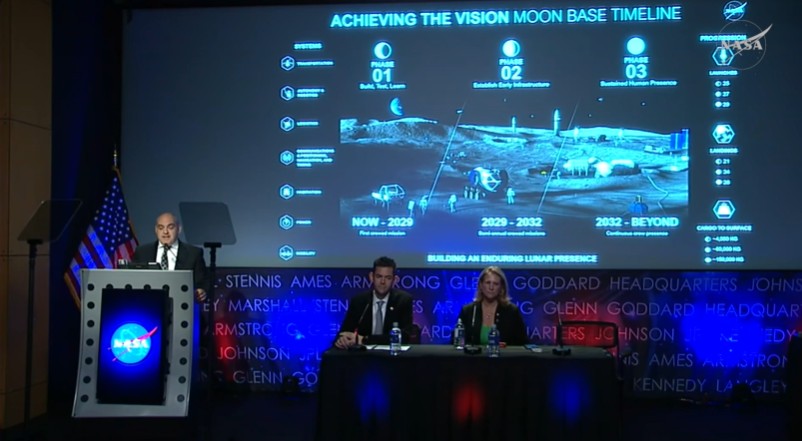
The half-century pause is now ending in a single decade. NASA Administrator Jared Isaacman announced the Ignition plan in March 2026, a ten-year, three-phase commitment to establishing a permanent Moon Base. Artemis II flew its crewed lunar flyby in April 2026. Under the Ignition plan's resequencing, Artemis IV is now targeting 2028 as the program's first crewed landing of the new era. The lunar economy that did not exist five years ago has become a coordinated industrial buildout, and it is racing against a tighter timeline than any lunar program has faced since Apollo. Six different programs now have active lunar surface efforts, led by China and joined by India, Japan, South Korea, and ESA. The surface is not contested in the sense of conflict, but several parallel programs are now racing toward it, and their pace has become a real constraint on what the next decade looks like.
This is not just a return to the Moon. As the closest gravity well to Earth, it is the most logical place to prove humanity can operate beyond its home planet at industrial scale. Every step that works on the lunar surface compounds into something larger. The autonomy that coordinates a rover fleet without continuous ground control on the Moon is the same autonomy that will coordinate one on Mars, and the techniques that turn lunar ice into propellant are the ones that will turn Martian regolith into oxygen. NASA's own framing for the Moon Base program names this directly, describing the skills mastered on the surface as explicit preparation for Mars. The lunar economy is the first step of an interplanetary one, where the working infrastructure gets built before it has anywhere further to go.
Any real economy rests on the same layers, mobility, communications, energy, and autonomous robotics, and each depends on the others. Mobility is the one that activates the rest. A power station no one can drive to is a stranded asset. A communications relay without endpoints is a tower in the dark. A sample no one can collect stays where it lands. Whichever company builds the mobility layer fastest, and builds it in a way that compounds across missions rather than ending after one, will determine how the rest of the lunar economy gets built. Lunar Outpost has spent the past nine years building toward that answer.
Justin Cyrus was born in Texas in 1992 and grew up in a neighborhood bordering NASA Johnson Space Center. His father had worked at NASA on human spaceflight, then served as Vice President at Lockheed Martin in the Moon to Mars office during the 1990s. The astronauts and engineers who designed the systems carrying humans into orbit were not abstractions to the Cyrus family. They were neighbors. Justin spent his childhood launching model rockets in fields alongside NASA engineers, attending leadership development programs at JSC, and absorbing the assumption that building things to leave Earth was what a serious career looked like.
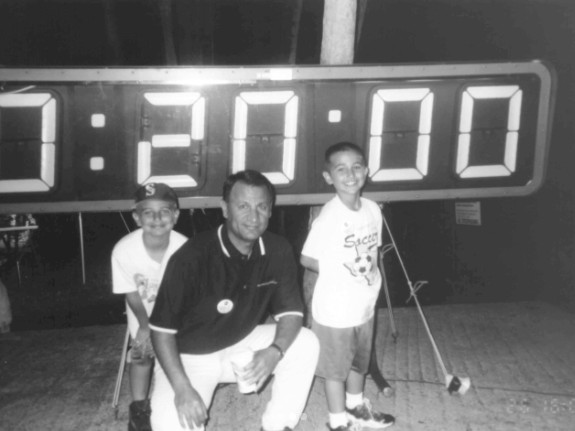
Julian Cyrus, his brother, followed the same gravitational pull. By the time both brothers were old enough to choose their own paths, they had already decided they would build a space company together. Justin earned his Bachelor's in Electrical and Computer Engineering at the University of Colorado Boulder, then a Master's in Electrical Engineering and Space Resources at the Colorado School of Mines. The Mines Space Resources program is the first academic track in the world built around the engineering and economics of extracting and using resources beyond Earth rather than around the science of studying them. Justin chose it deliberately, drawn to the question the legacy primes were not equipped to answer, whether space could become an industrial environment rather than a scientific one. Julian earned his engineering degree at UT Austin, then his Master's at CU Boulder, specializing in deep-space avionics.
Both brothers began their careers at Lockheed Martin, the company their father had spent years at. Justin worked on military satellite programs. Julian contributed to the Orion human spaceflight program, working on the vision processing unit, the emergency baro-altimeter, and other avionics components that would eventually carry crews to lunar orbit. The work confirmed something they had suspected from outside. The legacy model could build extraordinary single-mission systems, but cost-plus contracting rewarded delay and perfection over learning, and it could not produce the iterative, services-oriented infrastructure the next era would require. That would be built by a new kind of company, one that treated lunar hardware the way the smartphone industry treated mobile computing, building, testing, deploying, and letting the field teach it what to build next.
They founded Lunar Outpost in 2017. Forrest Meyen joined as the third founder shortly after, bringing direct heritage from MOXIE, the experiment that produced the first oxygen ever generated on another planet when it operated aboard NASA's Perseverance rover on Mars. His work focused on the solid oxide electrolysis stacks that cracked the Martian atmosphere into breathable oxygen, the foundational demonstration that resources beyond Earth could be turned into useful inputs rather than just studied. AJ Gemer joined the company in its first year as Chief Technology Officer and became central to the architecture of everything that followed. His decade at the Laboratory for Atmospheric and Space Physics at CU Boulder, working on mass spectrometers and instruments for cosmic dust analysis, anchored the technical direction of what would become the MAPP rover line and the autonomy software underneath it.
By the time the company began competing for major lunar contracts, the founding team combined deep heritage in lunar mobility, planetary resource utilization, spaceflight avionics, and instrument design. This was the combination that drew us in. We backed Lunar Outpost at the Seed stage in 2022, convinced that the lunar economy would be built by a company operating with this discipline before the category existed at all, and they have consistently delivered since.
The first product was Canary, an air quality sensor built for lunar habitat monitoring under Lockheed Martin's NextSTEP program, then turned into a real terrestrial business in methane detection and urban air quality. That dual-use instinct, one technology serving both space and Earth, became the company's operating discipline. Small NASA contracts followed, and the team learned to design for vacuum, dust, radiation, and thermal extremes by building hardware and watching how it behaved. In 2021, NASA Administrator Bill Nelson presented Lunar Outpost with a symbolic ten-cent check, representing ten percent of the company's one-dollar winning bid to collect a sample of lunar regolith. The dollar amount mattered less than what the transaction established. A commercial company had been paid by the U.S. government for material to be extracted from another world. It was the first sale of space resources in human history.

The company's signature rover line started small. The Mobile Autonomous Prospecting Platform, or MAPP, was a 10-kilogram class rover built for the constraints of early commercial landers, moving at 10 centimeters per second across a payload deck the size of a kitchen drawer. What mattered was not what any single MAPP could do, but what building it taught the company. Each build worked through the foundational problems of lunar engineering at a scale the team could iterate on hands-on, surviving the lunar night when batteries cannot be replaced, navigating shadows that reach hundreds of meters, and communicating when the nearest network is 384,000 kilometers away. Every build produced flight hardware that taught the next one what to fix.
Lunar Voyage 1 launched on February 26, 2025, aboard Intuitive Machines' IM-2 mission, carrying MAPP to the lunar South Pole. MAPP was set to become the first American robotic rover on the lunar surface since Apollo, the first commercial rover ever to operate on another planetary body, and the first rover at the lunar South Pole region. It also carried the resource-collection task the company had won on paper in 2021, the transaction LV1 was built to execute on the surface.
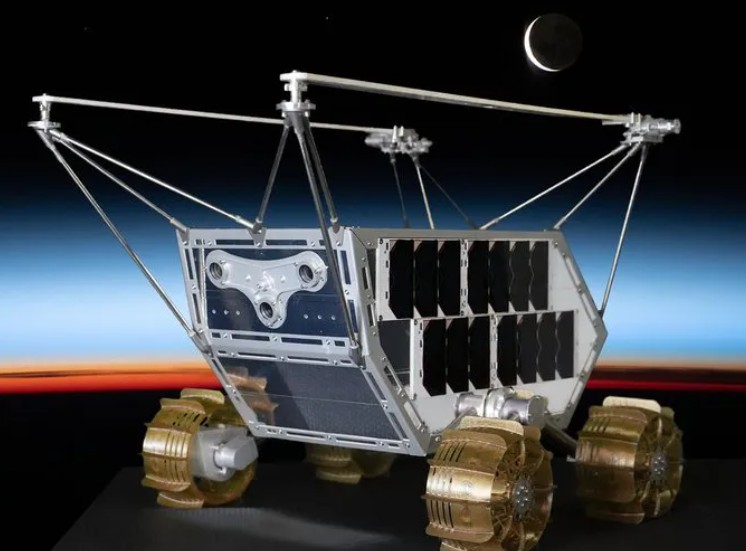
On March 6, 2025, the Athena lander touched down near Mons Mouton and came to rest at an off-nominal attitude, and the mission window closed within twenty-four hours before MAPP could roll onto the surface. What the rover did in that window is what mattered. In the real lunar environment, MAPP validated its navigation computer, its autonomous thermal control, its stereo navigation cameras, and the patent-pending Talon deployment system. It stood up the first commercial 4G/LTE network on the lunar surface in partnership with Nokia. The Stargate command and control software reached TRL 9, the highest technology readiness level NASA assigns, meaning it had been proven in the environment it was built for. The rover survived the landing intact and demonstrated every subsystem short of the drive itself. This is what flying real hardware looks like. You put systems on the surface, learn exactly what the surface does to them, and fly the next one better. Every lesson from LV1 fed straight into the builds that followed.
Lunar Voyage 2, set for the second half of 2026 aboard IM-3, carries MAPP back to the surface to study the Reiner Gamma magnetic anomaly and brings the first onboard GPU compute to the Moon. By integrating NVIDIA edge processors, Lunar Outpost lets the rover handle its own LiDAR feeds, map terrain hazards, and plan its own route in real time rather than waiting on a signal from 384,000 kilometers away. Missions stack up behind it. Lunar Voyage 3 follows in 2027, and Roo-ver, co-led with the Australian Space Agency, will be the first Australian rover on the Moon, built to turn lunar regolith into usable resources. Lunar Voyage 5 deploys with Artemis IV in 2028, the first robotic rover to work alongside astronauts on the surface. The MAPP platform carries all five, part of ten contracted missions launching before 2030, and each build was the same wager the intro laid out, that whoever masters movement on the surface first controls the layer every other part of the lunar economy has to plug into.
The transition from MAPP-class rovers to a human-rated lunar terrain vehicle required a step change in scale and complexity. Most companies would have started over. Lunar Outpost instead carried the same build-and-learn discipline up to the larger scale. Within twelve months, the company built seven distinct Eagle-class engineering prototypes, each designed to stress a different subsystem, from thermal control and mobility to autonomous navigation, the human-machine interface, and robotic arm integration. Each was a teacher the way MAPP had been, now scaled to a vehicle meant to carry astronauts across hundreds of kilometers rather than meters.
The Lunar Dawn consortium that formed around the Eagle effort assembled the partner ecosystem the program required. General Motors brought battery and electric drivetrain technology derived from its Ultium platform. Goodyear contributed non-pneumatic metal-mesh tires designed for regolith traction. MDA Space provided robotic manipulation systems. Leidos handled human-factors engineering and mission logistics. Each brought a capability that would have taken years to build internally, and integrating them under one mission architecture was the differentiator.
In late 2025 the Eagle program did something unusual for an aerospace company. It went on the road, covering 8,500 miles over 31 days and displaying the vehicle everywhere from the U.S. Capitol lawn to the banked oval at Talladega, drawing more than 125,000 visitors. Surviving a cross-country drive is a useful proxy for what the lunar surface demands, and the tour signaled to Congress, NASA, and the public that the hardware was real.

On May 26, 2026, NASA selected Lunar Outpost and Astrolab to deliver the first human-rated lunar terrain vehicles to the lunar surface. It was the first time in history that NASA had selected commercial companies to provide astronaut surface mobility as a service rather than build it in-house. The award narrowed the three Phase 1 finalists down to two providers for the flight hardware phase.
The selection came as a $220 million firm-fixed-price task order to advance Pegasus, the lighter LTV variant unveiled earlier in 2026. Built to carry two astronauts side by side in a low-profile form that echoes the Apollo rover, Pegasus drives in three modes, crewed, teleoperated from Earth, and fully autonomous, at speeds of more than 9 mph across a 900-kilometer range, operating for a full year on the surface and compatible with both the Blue Moon Mark 1 and Starship landers. To meet NASA's compressed schedule, the team iterated the heavier Eagle concept down into Pegasus using multiphysics simulation and digital twins, standing up two full-scale functional prototypes in record time. Those two prototypes have already been through two rounds of suited human-in-the-loop testing at Johnson Space Center with former NASA astronaut Dr. John Grunsfeld, evaluating crew fit, visibility, and the human-systems interfaces astronauts will rely on during Artemis IV, and Lunar Outpost is charting a path to delivering the flight vehicle to NASA in November 2027. Eagle remains the long-duration flagship, with Pegasus reaching the surface first and Eagle following on longer missions. The broader LTVS program carries a $4.6 billion ceiling through 2039, structured as per-mission task orders rather than one fixed contract, positioning Lunar Outpost to capture a substantial share across the demonstration and the recurring service missions that follow.

For half a century, lunar surface vehicles were government-built, one rover at a time, on government-scale timelines. Lunar Outpost got there by demonstrating that hardware iterated through small commercial missions can scale into the infrastructure NASA depends on, and it is now one of two companies building that infrastructure at the scale of a national program. A base is only as alive as the traffic moving through it. The vehicle that carries astronauts, tows the power plant to its site, and hauls regolith to the habitat is not one asset among many. It is the circulation the rest of the settlement depends on.
Rovers alone are not enough. The Moon will eventually host dozens of operational assets across multiple operators, programs, and nations, and coordinating them through Earth-based joystick control will not scale. The same discipline that produced MAPP and Eagle has, in parallel, produced a three-part software suite for running fleets as a coordinated workforce. Stargate is the command and control layer, already flight-proven on Lunar Voyage 1. Starweave is the swarm software that lets heterogeneous robots operate as one fleet. Spark is an AI mission operations assistant that handles telemetry analysis, anomaly detection, and real-time decision support. Each is its own product, and a recent $30 million Series B is funding the teams building them.
The engine behind Starweave, developed under U.S. Air Force Research Laboratory and Space Force SpaceWERX contracts as Mobile Autonomous Robotic Swarms, gets its first orbital test this year. MARS-1 launches in fall 2026 aboard a SpaceX Falcon 9 via an Exotrail transfer vehicle, and two small spacecraft will run decentralized cross-domain swarm operations in low Earth orbit, the first spaceflight test of software built to run on any asset, in any environment, on any world it reaches. Wheels move the mass, autonomy moves the coordination, and together they turn dozens of machines from different operators into one working fleet.
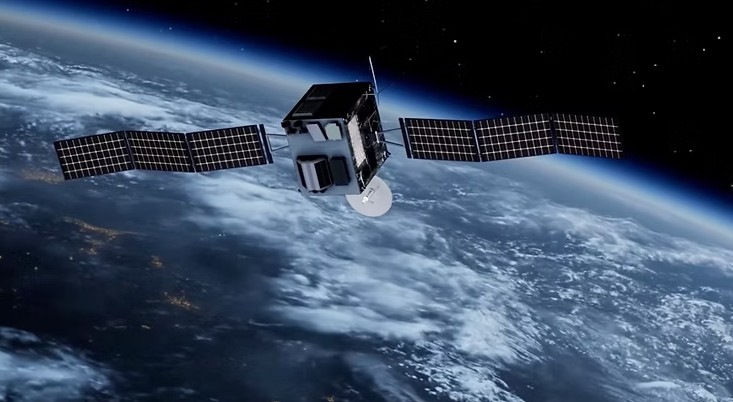
Lunar Outpost's work does not stop at the surface. The TACOS in-orbit demonstration, funded by the European Commission, is validating next-generation thermal architecture in low Earth orbit, the components that have to survive the swing into and out of orbital shadow. It flies as a pathfinder for something larger. In July 2026, Lunar Outpost Europe, the company's Luxembourg entity, was selected as thermal and systems-engineering lead for ESA's Moonraker, a lunar polar orbiter that will map the South Pole in 3D with near-infrared LiDAR to pick out safe landing sites, launching around 2030. The flight heritage from TACOS qualifies the thermal hardware Moonraker will carry, and both feed the company's LUX-Thermal platform, a proprietary architecture built to keep orbiting spacecraft and surface rovers alive through the two-week lunar night and its minus 173 degree cold.
The environment around Lunar Outpost has caught up to what the company has been building. The Ignition plan reoriented NASA toward what Isaacman has called operational urgency, meaning faster timelines, commercial procurement wherever possible, and a willingness to take on programmatic risk in exchange for actually getting hardware to the surface within the decade. The orbital Gateway has been paused. The Moon Base initiative anchors the agency's ten-year, three-phase roadmap, with infrastructure components moving from concept to procurement across every foundational layer.
That contract round made the buildout concrete. Blue Origin's Blue Moon Mark 1 Endurance lander will deliver the first Moon Base mission to the Shackleton Connecting Ridge no earlier than fall 2026. Subsequent missions include Astrobotic delivering Astrolab's FLIP rover, Intuitive Machines carrying the Lunar Vertex science investigation, and Firefly Aerospace delivering JPL's MoonFall drones. The first commercial LTV reaches the surface in 2028 via Blue Origin's lander.
Almost every component of that buildout depends on mobility. The 40-kilowatt fission surface power system targeted for 2030 arrives on a lander but reaches its site only by being towed across kilometers of terrain to a safe exclusion zone. Prospecting at Shackleton means traversing hundreds of kilometers of shadowed ground. Sample collection, habitat shielding, and relay installation all come down to moving mass and payloads between distant points. Mobility is the layer that turns every other layer from a single landing into something that operates.

The same pattern is taking shape internationally. China returned the first samples ever collected from the lunar far side with Chang'e-6 in 2024, has follow-on missions hunting South Pole water ice, and is developing a crewed rover for its 2030 landing, a six-wheel design built for a single mission of roughly six surface hours. India, Japan, ESA, and South Korea each have surface programs underway. The surface is filling up, and the architectures that scale fastest will define how it is used for decades.
This is what makes the commercial services model a structural advantage. A state-run program builds one extraordinary rover for one mission. A commercial market builds dozens, each refined against real operational data and scaling with demand, and Lunar Outpost is proving that model across borders, running programs for NASA, ESA, and the Australian Space Agency at once. When a national agency picks a commercial newcomer over its own incumbents to keep a lunar orbiter alive through the polar night, the model has stopped being a national advantage and become the way serious lunar programs get built. It is not the only commercial mobility company that exists, but it is the one that has flown, that earned TRL 9 on the surface, that was selected for the first commercial LTV deployment, and whose autonomy stack is being built to run on any asset, in any environment, on any world.
Picture the South Pole by the end of the decade. A Pegasus rover pulls away from a lander with an astronaut at the controls, tows a reactor to its exclusion zone, then doubles back to haul regolith to a half-built habitat wall, the ordinary rhythm of a working base. That is the difference between a flag planted and an economy built, and the wheels going down first on the Moon are the wheels the rest of the solar system will run on.


Our conviction has only deepened since we first backed the company. We have been inspired to watch Justin and Julian build the generational space company they set out to build before either of them had finished school. The team was already operating with the discipline the lunar economy would require before that economy was a category. They iterated hardware in the field rather than perfecting it in isolation. They built the software stack alongside the rovers. They earned flight heritage on small missions before they needed it on large ones. The work since then has spoken for itself.
Nine years after founding, the team has put the first commercial rover on the Moon, made that historic first sale of lunar material to the U.S. government, and been selected by NASA to deliver one of the first human-rated lunar terrain vehicles to the surface, with ten missions contracted ahead of them. The fifty-three-year silence is ending, and what replaces it will not look like Apollo. It will look like an actual economy, with many operators, many nations, and the working infrastructure moving beneath all of it. That economy is already being built by a company NASA, ESA, and the Australian Space Agency have each chosen to move their people and cargo across the surface. Someone has to lay down the layer everything else moves across, and Lunar Outpost is building it first. We are proud to be backing the team that gets there.
