SpaceX didn't just build a better rocket — it rewrote the economics of what's possible in space. In this portfolio spotlight, we break down how collapsing the cost of launch created a self-reinforcing flywheel spanning reusable rockets, global connectivity, deep space infrastructure, and orbital AI compute, and why we believe this is the most consequential company in the world.
When we first backed SpaceX in 2017, few venture investors grasped the generational opportunity in space or deep tech. Most saw SpaceX as a capital-intensive launch company with significant scaling challenges, few believing hardware could be iterated at the pace software demanded, and underestimated what a world-class team driven by mission could accomplish. What we saw was the invisible backbone of the global economy.
Our conviction rested on three beliefs: that transparent launch pricing would unlock an entirely new generation of infrastructure companies, that reusability would fundamentally change the economics of space, and that Starlink could become a Tier 1 internet service provider (ISP) bridging the digital divide at global scale. Each has proven correct, and Starship now scales existing business lines while unlocking entirely new markets, firmly positioning SpaceX a decade ahead of its competitors and well beyond even our $1T price target.
From Orbital Scarcity to Abundance
For six decades, every rocket was built to fly once. Payloads were delivered and boosters disintegrated over the ocean. By the 2000s, United Launch Alliance (ULA), a joint venture between Boeing and Lockheed Martin formed to consolidate America's military launch capability, exemplified this model: the Delta IV Heavy cost over $400M per launch, while the smaller Atlas V cost $140M. The model worked when governments were the only customers and cost was secondary to capability, but it made orbital access incompatible with commercial operations at scale. Because launch was so expensive, spacecraft were built for perfection on the first attempt, with manual testing and verification processes that stretched timelines and drove up costs. The entire industry optimized for zero failures over iteration speed, producing procurement cycles measured in decades and budgets measured in billions. Pricing reflected this opacity. Government contracts were negotiated behind closed doors, costs were never published, and commercial operators had no reliable basis on which to build a business around orbital access.
SpaceX's founding bet was that this scarcity came from economic structure, not physical necessity. Rockets burned up not because they had to, but because no one had incentive to bring them back. If refurbishment cost more than building new hardware, reusability was a financial liability rather than an asset. But if the cost of inspecting, refurbishing, and re-flying a booster could be kept below the cost of manufacturing a replacement, the entire industry's cost structure would change. Proving that required solving problems the incumbents had dismissed as impractical, and the road to doing so was neither straight nor short. Early development of the Merlin engine, first built to power the Falcon 1 and later the rocket motor at the heart of the Falcon 9, faced cracked aluminum manifolds, forcing a pivot to inconel, a nickel-chromium alloy capable of surviving extreme thermal stress. The second Falcon 1 flight in 2007 failed due to propellant slosh in the second stage, an anomaly that could have been prevented with a few thousand dollars worth of sheet metal baffles, bringing down a $7 million rocket and nearly ending the program. The fourth Falcon 1 flight in 2008 finally reached orbit, with SpaceX reportedly days away from running out of funding when it did. The fifth Falcon 1 then launched the company’s first customer payload in 2009. Even after the first Falcon 9 delivered its payload successfully in 2010, the vision of landing and reusing boosters was dismissed by industry veterans as a publicity stunt that traded performance for spectacle.
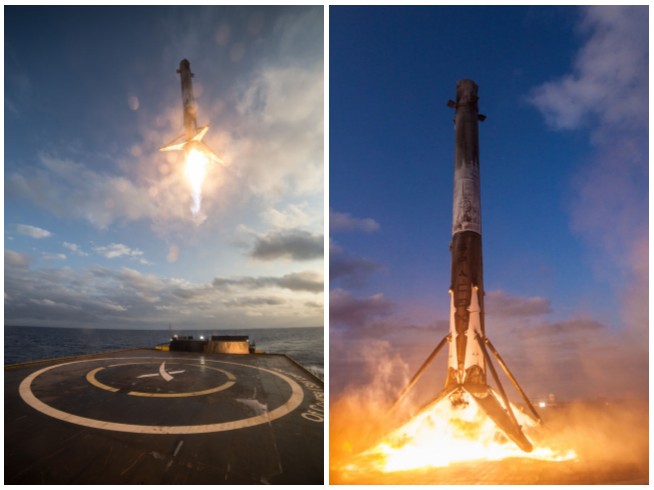
What changed the calculation was vertical integration. SpaceX brought around 85 percent of its systems in-house, not as an ideological choice but out of necessity. When suppliers couldn't meet the pace or cost targets required for reusability, SpaceX built its own engines, avionics, fairings, and eventually the factory robots that assembled them. By controlling the entire production stack, the company could iterate at software speed, compressing design cycles from years to months and eliminating the third-party markups that had kept launch prices artificially high. The inflection point arrived on March 30, 2017, with the SES-10 mission, when for the first time an orbital-class booster that had flown in April 2016 lifted off again, delivered its payload to geostationary transfer orbit, and landed on a drone ship in the Atlantic. The mission validated what incumbents had refused to believe, that a used rocket, properly refurbished, could be as reliable as a new one at a fraction of the original cost. SpaceX's fixed list pricing made orbital access predictable for the first time, enabling a new generation of companies to build businesses around it.
Figure. The Falcon 9 booster B1021 from the SES-10 mission descending onto SpaceX's drone ship in the Atlantic, March 2017, the same booster that had already flown to orbit nearly one year earlier, marking the moment reusability became commercial reality. (image source)
Our 2017 investment was anchored in exactly this. What drew us to SpaceX a decade ago wasn't the rocket landings, impressive as they were, but the economic transformation they represented. If reusability could bring launch costs down far enough to make large constellations viable, and those constellations could generate the revenue to fund larger vehicles, and those vehicles could unlock markets that had never existed before, the cost curve would compound in ways the industry hadn't seen. We believed that logic was sound, and the economics of what followed are the evidence.
By amortizing the cost of a Falcon 9 booster, which represents roughly 60 percent of the vehicle's total expense, across twenty or more flights, SpaceX reduced its internal marginal cost per launch to an estimated $15 to $20 million. This figure includes propellant, fairing recovery and refurbishment, and the amortized cost of the booster itself. With a public list price stable at approximately $70 million since 2022, the company operates at margins exceeding 70 percent, unheard of in an industry where traditional providers, burdened by cost-plus contracts and fragmented supply chains, struggled to break even. By 2025, that advantage had widened considerably. SpaceX conducted 165 Falcon 9 launches, averaging one flight nearly every two days and representing roughly 85 percent of all American orbital missions. Its annual output nearly doubled China's entire state-backed launch sector, which conducted 92 launches across multiple providers. The company carried approximately 85 percent of the world's total payload mass to orbit. Critically, this wasn't the result of superior marketing or favorable contracts. It was the result of reusability enabling a launch cadence that no competitor could match, which in turn drove the utilization rates that justified further cost reduction. The scale economics multiply rather than add: the more flights per booster, the lower the marginal cost per launch, the more demand those lower prices unlock, and the higher the production volumes that push unit costs down further still.
That industrial rhythm set the foundation for Starship, the most powerful rocket ever built, producing more than double the liftoff thrust of the Apollo-era Saturn V, and a fully reusable system designed to extend the same economic model to payloads an order of magnitude larger. Where Falcon 9 lifts 22 metric tons to low Earth orbit, Starship is built to carry 100 metric tons or more with full reusability, rising to 200 metric tons with its Version 3 architecture. It uses liquid methane as propellant, which simplifies engine refurbishment by reducing carbon buildup compared to the kerosene used in Falcon 9's Merlin engines. Its stainless steel structure costs roughly $3 per kilogram compared to $200 per kilogram for the advanced carbon composites used in most modern aerospace vehicles, making it economically viable to build at scale.
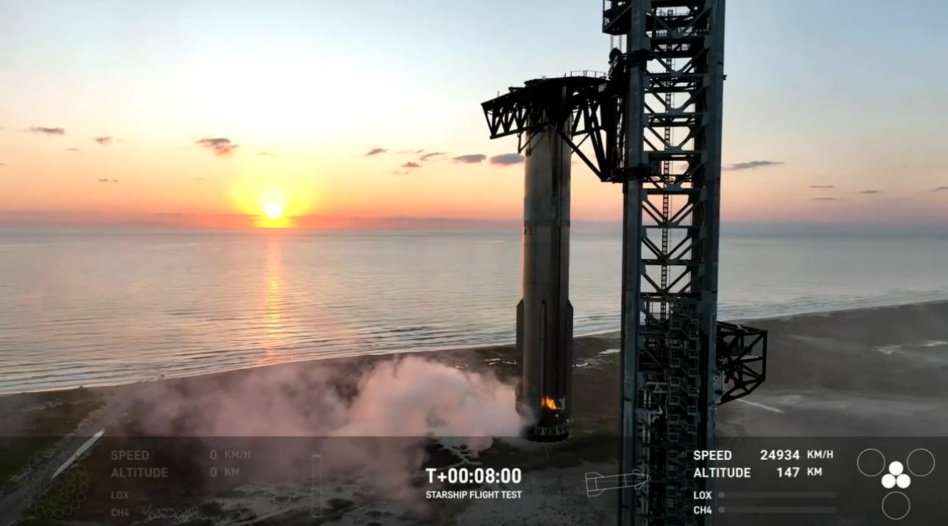
At the Starbase facility in Texas, the Starfactory has been designed with theoretical capacity to produce 1,000 Starships per year, though the achieved rate remains in its early stages, closer to one vehicle every one to two weeks. As of early 2026, Starship has completed eleven integrated flight tests, achieving a 100% ascent and stage separation success rate across the last six missions and a rapidly improving booster recovery success rate. The program's most visible milestone was the successful catch of the returning Super Heavy booster using the launch tower's mechanical arms on October 13, 2024, eliminating the need for landing legs and enabling rapid turnaround. For a deeper look at what opportunities Starship unlocks across the space economy, see our report Starship: The Next Giant Leap.
Figure. The Starship Super Heavy booster caught by Mechazilla's chopstick arms at Starbase, Texas, October 2024, the first time a booster of this scale had ever been caught rather than landed, and refined across subsequent flights through upgraded sensors, reinforced arms, and improved control software. (image source)
Starship's value isn't simply that it can lift more mass to orbit, but that it can do so cheaply and frequently enough to make what comes next economically viable. Cheap launch alone, though, doesn't create a deflationary engine. The deflation compounds when lower costs generate demand, demand funds expansion, and expansion drives costs lower still. But that cycle only starts if there is enough consistent demand to keep the flywheel turning, and in the mid-2010s neither commercial satellite markets nor government contracts could provide that at the scale SpaceX needed. The answer was to generate that demand internally, by becoming its own largest customer at a scale no external contract could match.
The Economics of Ubiquity
The same deflationary logic that broke open the launch market is now rewriting the economics of global connectivity. For generations, the map of human connectivity has been a series of dense urban nodes connected by fiber-optic cables, surrounded by vast regions where the internet remains slow, intermittent, or entirely absent. This isn't a failure of engineering ambition but a constraint of infrastructure economics. To deliver city-grade broadband, terrestrial providers must lay thousands of miles of cable or erect high-frequency cellular towers, investments that only make sense where subscriber density is high enough to amortize the upfront capital.
As population density falls, cost per subscriber rises, leaving rural farmland, maritime corridors, and remote industrial sites as permanent digital dead zones. Industries requiring real-time data flows clustered in cities not because talent or markets demanded it, but because connectivity did. Offshore drilling platforms, transcontinental shipping routes, and agricultural supply chains operated in enforced informational isolation, collecting data locally but lacking the bandwidth to process it centrally or share it in real time. Legacy satellite internet provided little more than basic connectivity. Geostationary satellites, parked 35,000 kilometers above the equator in a fixed position relative to Earth's surface, could blanket continents with coverage but were inherently limited by physics. The round-trip signal delay of 500 to 700 milliseconds made them poorly suited for modern applications, where video calls were choppy, financial transactions lagged, and workflows built around cloud software broke entirely. For aviation and maritime transport, these systems provided just enough bandwidth for basic position reports but left operators blind to the real-time diagnostics, fuel optimization, and predictive maintenance that terrestrial networks enabled.
Starlink addressed this by deploying a constellation at just 550 kilometers altitude, much closer to Earth than traditional satellites, reducing signal travel distance by a factor of 60 to 70x compared to geostationary systems. Latency fell to 25 to 55 milliseconds, competitive with terrestrial fiber and low enough to support the real-time interactions modern digital infrastructure requires. But the more consequential shift was structural. By building a network designed for global coverage from the outset rather than expanding incrementally from urban centers, Starlink eliminated the capital-density trap that had constrained terrestrial providers for generations. Coverage became a function of orbital mechanics rather than subscriber concentration. A satellite passing over the Amazon rainforest delivers the same bandwidth as one passing over Manhattan. The marginal cost of serving a remote oil rig or a mining operation in a region with no prior connectivity is identical to serving a suburban home, yet those industrial operators typically pay subscription rates many times higher, making the economics of ubiquity work in both directions. Every orbit generates revenue across multiple customer segments simultaneously, a business model impossible for ground-based providers constrained by the economics of building towers in low-density regions.
Figure. Starlink as tracked by LeoLabs, the leading ground-based space situational awareness data company. A continuous shell of satellites covering every ocean, desert, and polar region, reaching people and industries that terrestrial networks were never designed to serve and could never economically justify. (image source)
As the subscriber base grows from tens of thousands toward hundreds of millions, cost per user continues falling while network capacity scales upward with each new launch. For autonomous systems, this shift is equally significant. Autonomous vehicles, logistics drones, and the broader ecosystem of connected machines function most effectively with persistent, low-latency connections that terrestrial networks cannot reliably provide beyond urban areas, limiting their full potential. Terrestrial networks are incompatible with mobile agents operating beyond urban infrastructure. Fiber cannot follow a mining fleet across a desert. Cellular towers cannot track a shipping container across an ocean. Starlink provides the connection that allows distributed intelligence to function as a coordinated system, turning isolated machines into nodes in a planetary-scale network.
Beyond transforming global connectivity, Starlink's significance to SpaceX runs deeper than its role as the company's primary revenue engine, fundamentally changing how the entire business scales. Traditional aerospace companies built rockets and then waited for customers to emerge, a model producing slow, government-dependent revenue cycles and chronically low utilization rates. SpaceX inverted this by becoming its own largest customer. By early 2026, Starlink had deployed over 9,600 satellites and crossed 10 million subscribers across consumers, enterprises, aviation, maritime, and defense customers, a milestone that validates the scaling thesis and demonstrates that demand is accelerating rather than plateauing. This self-generated demand created a guaranteed launch cadence that no external contract could match, allowing the company to iterate hardware, refine operations, and drive down costs at a pace competitors depending on government bids simply couldn't sustain.
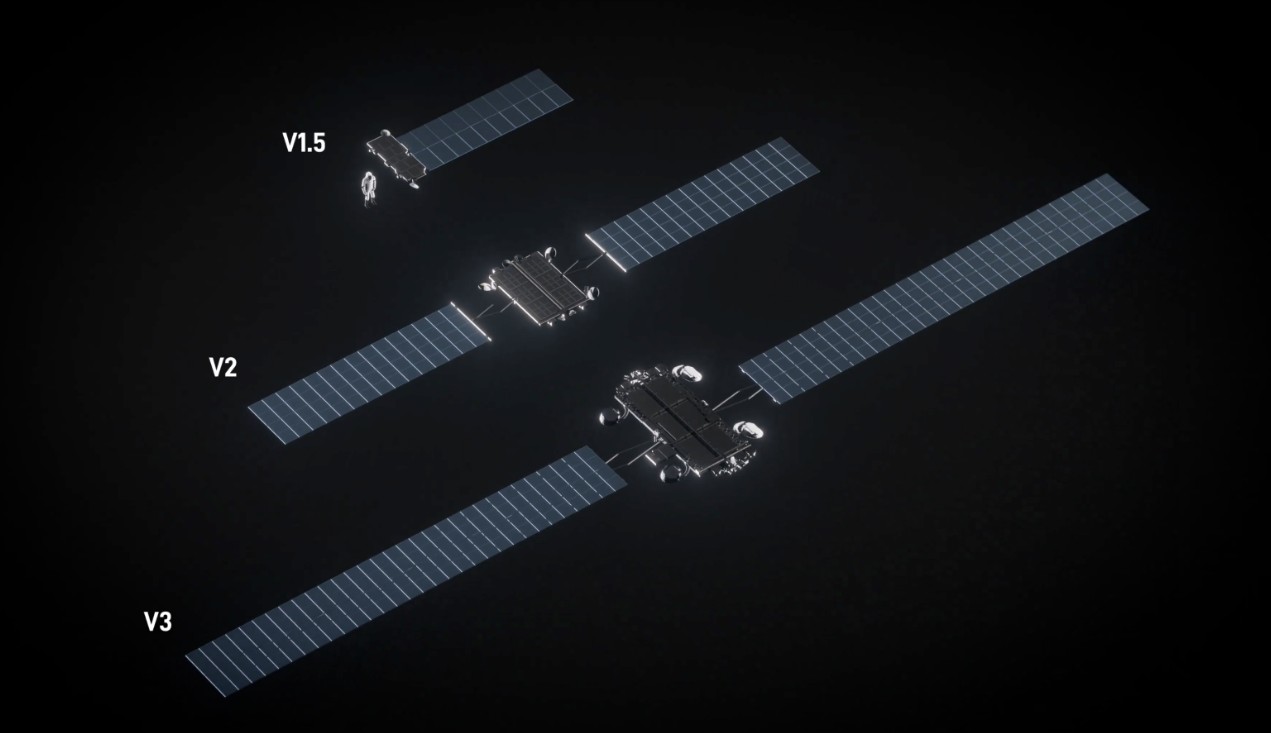
Figure. Three generations of Starlink satellites, V1.5 to V2 to the forthcoming V3, each iteration bringing larger solar arrays and greater capacity, with V3 delivering more than ten times the throughput of its predecessors and designed to be deployed exclusively by Starship. (image source)
SpaceX reportedly generated approximately $8 billion in profit on $15 to $16 billion in revenue in 2025, with Starlink estimated to account for roughly 80 percent of that income, making it the primary engine behind the company's economics. This is what closes the first loop in the flywheel. That cash flow funds Starship development directly, which in turn enables deployment of Starlink V3, a next-generation satellite design weighing approximately 2,000 kilograms each, roughly six times heavier than most satellites in the existing constellation, and delivering more than 1 terabit per second of downlink capacity, roughly ten times what those satellites provide. A single Starship launch carrying 50 to 60 of these satellites will add 60 terabits per second to the network, a twentyfold increase over what Falcon 9 delivers today.
The revenue from the current network pays for the vehicle that makes the next-generation network possible, and that network generates the revenue to fund whatever comes after. By controlling both the launch vehicle and the primary payload, SpaceX has separated its growth from external demand cycles entirely. Any competitor relying on third-party launch services cannot match the integrated economics of a company that owns every margin from propellant to processing, and that structural gap widens with each satellite deployed.
From Expeditions to Infrastructure
The deflationary engine doesn't stop at low Earth orbit. Human expansion beyond low Earth orbit has been constrained for more than half a century not by the difficulty of reaching space but by the economics of staying there. To travel from Earth's surface to any destination beyond orbit, a vehicle must carry enough propellant to accelerate its payload, plus the propellant needed to accelerate that propellant, in a recursive spiral consuming most of the vehicle's mass. By the time a spacecraft reaches low Earth orbit, it has burned through roughly 90 percent of its launch mass just overcoming Earth's gravity. The Apollo program exemplified this constraint. Each lunar mission required a Saturn V weighing 3,000 metric tons at liftoff to deliver approximately 45 tons to lunar orbit, of which roughly 15 tons reached the surface. The Lunar Module could stay for only three days before life support and propellant reserves expired. The missions succeeded as demonstrations of capability but failed as models for sustained presence, because without local resources to offset the cost of resupply from Earth, every habitat module, every tool, every liter of water had to be hauled up from the bottom of Earth's gravity well at costs measured in hundreds of thousands of dollars per kilogram.
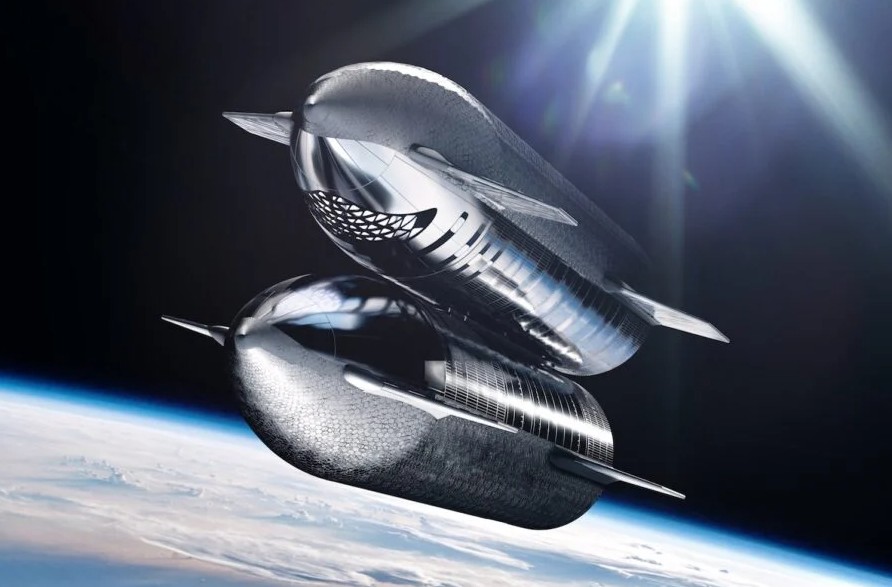
Figure. A SpaceX render of two Starships docked in low Earth orbit for propellant transfer, a capability that once proven separates the mass required to escape Earth's gravity from the mass required to reach anywhere beyond it. (image source)
SpaceX's answer to this is orbital refueling, a capability that resets the rocket equation at the point where it matters most. While small-scale refueling of satellites and space stations using stable hypergolic propellants has existed since the 1970s, transferring hundreds of tons of cryogenic liquid methane and oxygen between rockets in microgravity has never been attempted before. The engineering is far from trivial. Unlike conventional fuels, cryogenic propellants must be kept at extreme temperatures below minus 180 degrees Celsius, and in zero gravity they don't sit at the bottom of a tank but float in unpredictable formations, requiring the tanker to fire small thrusters to create artificial gravity and force the liquid into a pumpable position. SpaceX completed a first internal tank transfer during Starship's third flight test in 2024, establishing proof of concept. A ship-to-ship transfer demonstration is being scheduled for 2026, marking the first attempt at external cryogenic refueling at scale.
Instead of launching a spacecraft fully fueled from Earth's surface, the system launches tankers and cargo vehicles separately, then transfers propellant in low Earth orbit before departure. A Starship arriving in LEO nearly empty can be refilled from multiple tanker flights, allowing it to depart with its full payload capacity and enough fuel to reach the Moon, Mars, or beyond. This separates the mass required to escape Earth's gravity from the mass required to conduct operations elsewhere, and it only becomes economically viable when launch costs are low enough to make multiple tanker flights per mission financially sensible, which is precisely what Falcon 9's reusability and Starship's scale are designed to achieve. If the 2026 demonstration succeeds, it establishes a persistent refueling capability in orbit allowing missions to depart LEO without the rocket equation dictating their design. NASA's Artemis III mission, currently scheduled no earlier than 2028, depends on this system working. That delay, driven largely by the slower pace of NASA's own Orion and SLS program, only reinforces why SpaceX is moving aggressively to build its own lunar infrastructure rather than waiting on government timelines.
On February 9, 2026, Elon Musk announced that SpaceX is pivoting focus toward building a permanent presence on the Moon before Mars. The reasoning is logistical. Mars, with its 26-month launch windows dictated by orbital alignment and six-month one-way transits, offers no room for rapid iteration. A critical failure in hardware or life support could take years to diagnose and correct. The Moon, by contrast, sits two days away with launch opportunities available every ten days, and a round-trip communication signal takes roughly 2.5 seconds, making real-time remote operation genuinely feasible. Mars, by comparison, has a round-trip signal delay of anywhere from 6 to 44 minutes depending on where the planets are in their orbits, making rapid iteration from Earth effectively impossible. This proximity transforms the engineering challenge from a single high-stakes mission into a continuous supply chain where components can be tested, adjusted, and replaced on timelines measured in weeks. It is the same industrial rhythm that drove SpaceX's success with Falcon 9, rapid cadence creating tight feedback loops that compound learning faster than any competitor operating on government timelines.
Figure. SpaceX's Starship lunar variant on the Moon's surface, selected by NASA as the Human Landing System for Artemis III, targeting 2028 for the first crewed lunar landing since 1972, and unlike Apollo, built to return again and again as the first link in a permanent lunar supply chain. (image source)
The economic viability of permanent off-world presence depends on using local resources. Lunar regolith, the loose rock and dust covering the Moon's surface, contains roughly 45 percent oxygen by mass, which can supply both breathable air and the oxidizer component of rocket propellant. Water ice confirmed in permanently shadowed craters near the lunar poles can be split into hydrogen and oxygen through electrolysis, providing life support and fuel. On Mars, the thin carbon dioxide atmosphere can be combined with subsurface water to produce liquid methane and oxygen through the Sabatier reaction, a chemical process that has been used in industrial settings on Earth for over a century, and which happens to produce the same propellant combination Starship uses, allowing vehicles to refuel on the Martian surface without hauling every liter from Earth.
A settlement becomes economically viable at the point when local production costs drop below Earth resupply costs, a threshold that depends on launch costs, local resource density, and processing efficiency, and one that only becomes reachable once launch costs have fallen far enough to make the initial infrastructure deployment justifiable in the first place. This is why the economics of deep space are not separate from the economics of reusability. They are downstream of the same cost curve that began with the SES-10 landing in 2017. The historical parallel holds across maritime shipping, transcontinental rail, and fiber-optic cables. Each transformed the economics of its era not through a single breakthrough but by lowering the cost of moving goods, people, or information below a threshold that made previously impossible activities suddenly viable.
The Homestead Act of 1862 is perhaps the most direct precedent: the US government made land free to anyone willing to settle and develop it, but that offer only became meaningful once the transcontinental railroad lowered the cost of reaching and supplying those settlements. The railroad didn't just enable settlement, it became the foundation of American economic prosperity for the following century. The economics of settlement followed the infrastructure, not the other way around. Whether that pattern holds beyond Earth remains to be seen, but Starship is the equivalent infrastructure layer for space, moving hundreds of tons per mission rather than the few tons historical missions managed. Communication, power, and life support will be as essential as the rockets themselves, and SpaceX is expected to lead that build-out as the expansion from expeditions to permanent infrastructure takes shape. As an extension of the company’s orbital data center ambitions, SpaceX has already outlined plans for lunar factories and giant electromagnetic catapults that fling payloads off the Moon without rocket fuel, to manufacture and launch AI satellites directly from the lunar surface, with an expectation that within two to three years, space will be the lowest-cost environment to generate AI compute.
Abundant Energy, Unlimited Intelligence
The most consequential application of collapsing launch costs may not be connectivity or deep space at all, but intelligence itself. The artificial intelligence revolution has run into a constraint no amount of software optimization can resolve. Surging demand for AI training and inference has pushed data centers to the edge of what Earth's power grids and cooling systems can support. The largest hyperscale facilities now approach or exceed one gigawatt of electricity consumption, roughly equivalent to the output of a large nuclear power plant. In the United States, utilities in major tech hubs report average wait times exceeding four years to connect new data centers to regional grids. These constraints are rooted in the thermodynamics and capital economics of ground-based computing. Terrestrial data centers operate where energy is scarce and expensive, where cooling requires water-intensive chillers, and where land availability is increasingly limited. As AI models grow from hundreds of billions to trillions of parameters, energy and cooling demands rise faster than efficiency improvements can offset them.
SpaceX's response, formalized in a January 30, 2026 FCC filing, is to relocate a significant portion of AI compute infrastructure to orbit. The proposal outlines a constellation of up to one million satellites dedicated to data center operations, distinct from, but interconnected with, the existing Starlink network. In sun-synchronous orbits, a class of polar orbit designed to maintain near-constant solar exposure throughout the year, arrays operate at a capacity factor of 95 percent or higher, uninterrupted by weather, atmospheric scattering, or day-night cycles. In its FCC filing, SpaceX contends that by directly harnessing near-constant solar power with minimal operating and maintenance costs, orbital data centers can achieve a level of cost and energy efficiency that terrestrial infrastructure, constrained by grid access and cooling demands, has so far been unable to replicate. The thermal advantage is equally significant. Modern AI accelerators can generate hundreds of watts of heat per chip, and terrestrial data centers use massive chillers, cooling towers, and liquid-cooling loops to manage this load, consuming enormous amounts of water and electricity in the process. In the vacuum of space, thermal energy can be radiated directly into the near-absolute-zero background through purpose-built radiator surfaces, allowing heat to dissipate without the chillers, cooling towers, and water systems that make terrestrial computing infrastructure expensive.
The physics make a compelling case, but large-scale orbital data centers have not existed before now because three fundamental engineering barriers have stood in the way. The first is thermal: while the vacuum of space allows heat to radiate into the near-absolute-zero background, managing that at scale requires purpose-built radiator surfaces sized for peak loads across thousands of satellites. The second is cosmic radiation. Low Earth orbit is a hostile environment where cosmic rays and solar energetic particles can flip bits in memory and degrade semiconductor performance over time. Traditional solutions rely on radiation-hardened chips that cost 10 to 100 times more than commercial processors and lag several generations in performance. The emerging approach combines moderate shielding with error-correction algorithms that detect and fix bit flips in real time, allowing modern GPUs and AI accelerators to operate reliably in orbit without the full cost of radiation hardening. The third is maintenance. Terrestrial data centers benefit from easy physical access, where technicians can swap failed components and reconfigure infrastructure in hours. Orbital systems must tolerate failures without human intervention, mirroring the resilience model SpaceX developed for Starlink, where the network is sized to absorb routine losses from solar storms, micrometeorite impacts, and end-of-life deorbits, with replacement satellites launched continuously as part of normal operations. For sustained high-density inference and long-duration training runs, the economics increasingly favor orbit, as Starship drives launch costs down toward levels where continuously replacing satellites could become cheaper than maintaining equivalent terrestrial facilities.
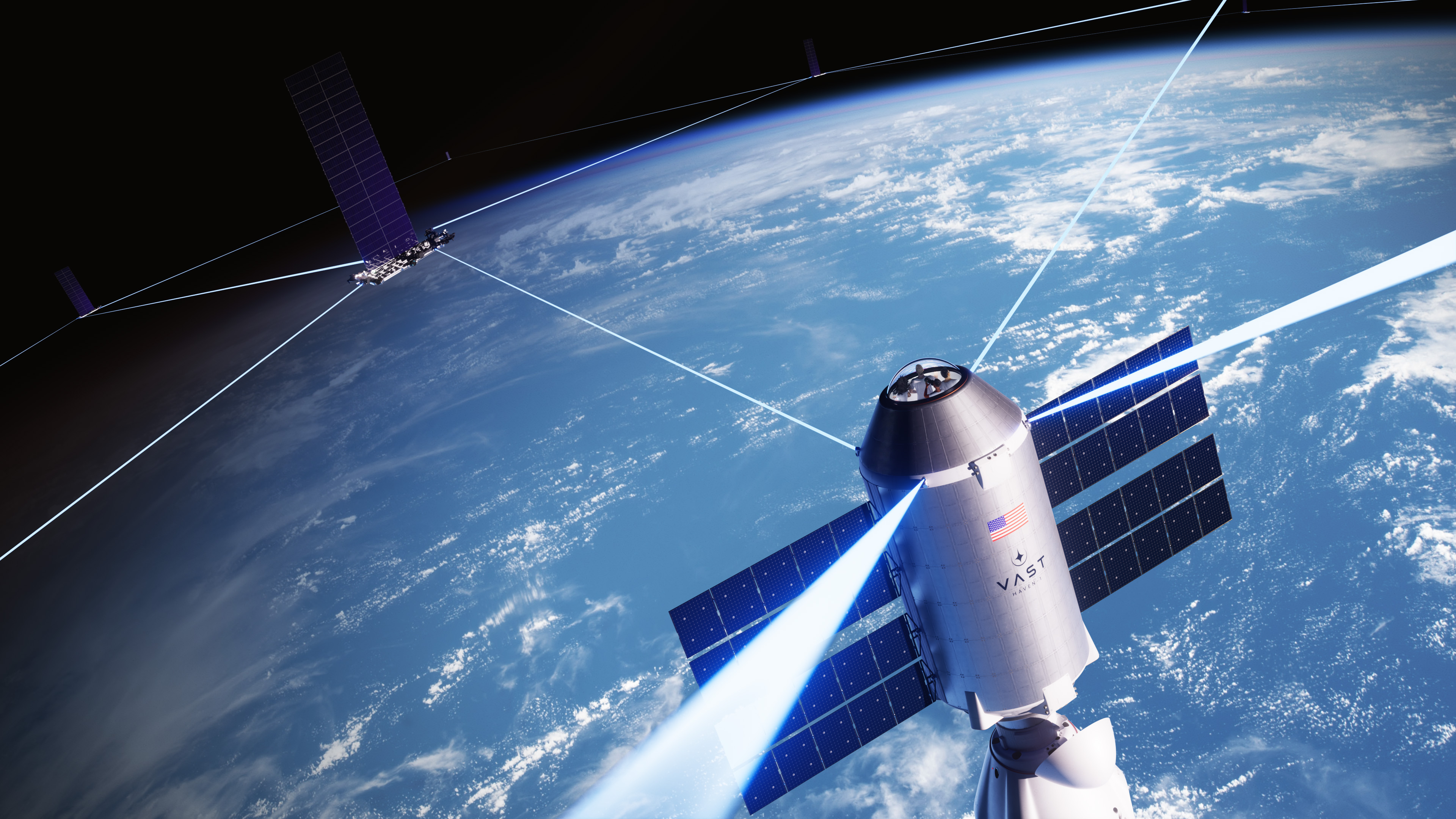
Figure. The Starlink laser mesh is set to deliver fiber-like speeds to Vast's Haven-1, the first commercial space station to be connected by Starlink, transforming it from an isolated outpost into a node on what is becoming the fundamental connectivity backbone for orbital platforms and compute infrastructure at scale. (image source)
The system uses the Starlink laser mesh, a network of inter-satellite optical links that pass data between satellites at the speed of light, as a 25-gigabit-per-second connection routing data between orbital compute nodes and ground stations with latencies competitive with terrestrial fiber over continental distances. For applications like real-time geospatial analysis, climate modeling, or global logistics coordination, where input data originates from satellites or is distributed across multiple continents, processing at the edge reduces the need to downlink massive raw datasets and allows insights to be delivered with minimal delay. SpaceX has outlined a goal of adding 100 gigawatts of AI compute capacity annually through this constellation, a scale only achievable because Starship's payload capacity makes orbital deployment cost-competitive with building new terrestrial facilities in power-constrained regions.
The filing has attracted scrutiny from the FCC and international bodies over orbital debris risks, including concerns about Kessler Syndrome, the theoretical cascade of collisions that could render certain orbits unusable. Those concerns are real, but SpaceX arguably has the greatest incentive, and is already building the infrastructure, to address them. In January 2026, the company launched Stargaze, a constellation-wide space situational awareness system that uses the existing Starlink fleet's onboard sensors to screen roughly 30 million orbital transits per day, detecting potential collisions in minutes rather than the hours traditional ground-based radar requires. Combined with its integrated ownership of the launch vehicle and the ability to guarantee rapid deorbiting of failed units, SpaceX is arguably better positioned than any other entity to manage orbital traffic responsibly at this density.
On February 2, 2026, SpaceX acquired xAI, the artificial intelligence company it is now strategically aligned with, in a stock-swap transaction valuing the combined entity at $1.25 trillion. The merger gives SpaceX a dedicated customer for orbital compute at the scale required to justify infrastructure build-out, while xAI gains access to compute resources unconstrained by terrestrial grid limitations. The same company now controls the launch vehicle, the orbital data center, the connectivity backbone, and the AI workloads running on top of it, completing a vertical stack that competitors cannot replicate without rebuilding every layer from the ground up. The xAI merger, combined with SpaceX's June 2026 IPO, which raised roughly $75 billion at a $1.77 trillion valuation in the largest public offering on record, gives SpaceX the capital base to accelerate that full-stack vision at a pace private funding alone could not sustain. Together they represent the market's recognition that collapsing the cost of space access has produced something far larger than a space infrastructure company, an AI-driven global intelligence platform that is quietly rewriting the economics of civilization from orbit.
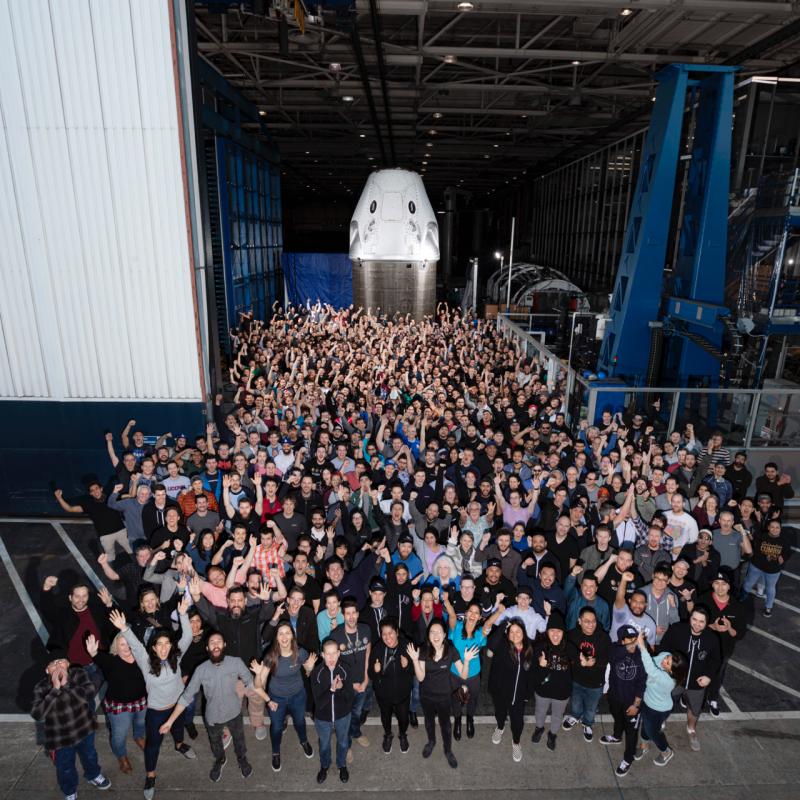
Figure. The culture of first principles engineering and relentless iteration that SpaceX built has become one of the most influential forces in modern technology, producing a generation of founders and engineers now tackling the world's hardest problems across every industry, which will in turn accelerate what becomes possible in space. (image source)
What SpaceX has constructed across these four domains is an economic architecture where each layer funds and enables the next. Cheap, reusable launch made large constellations financially viable. Starlink's compounding revenue funds Starship development. Starship's payload capacity makes next-generation Starlink satellites and orbital data centers deployable at costs that close commercially. And the energy and compute infrastructure that emerges from orbit addresses the very bottleneck threatening to constrain AI development on the ground. The cycle is deflationary and self-reinforcing: falling costs unlock new demand, new demand justifies higher production volumes, higher volumes drive costs lower still. The space economy has grown tremendously, with a new generation of public companies and emerging unicorns across tech layers of Infrastructure, Distribution, and Applications benefiting from the more accessible and competitive launch environment that SpaceX helped create. SpaceX has become the world's most effective leadership factory, producing a rapidly growing ecosystem of over 149 SpaceX alumni-founded startups collectively raising over $11 billion. Many are applying the same first principles culture to the world's hardest problems, from energy and autonomous transport to AI and defense, helping fix the industrial base in ways that complement and strengthen the space economy.SpaceX's IPO accelerates this further, moving a generation of engineers from equity-rich to cash-ready and unleashing a supercycle of unconstrained builders. Historically, roughly a third continue building in the space sector, creating infrastructure that feeds directly back into SpaceX's own ecosystem and drives costs lower still. We are grateful to have backed many of the exceptional founders among them, and expect this cycle to compound for decades.
SpaceX is our largest portfolio position, measured both by capital invested and fair market value, which is anchored in a thesis that has only deepened since our initial investment in 2017. The impact of GPS over two decades has demonstrated how a single orbital infrastructure layer can quietly transform an entire economy. Starlink and orbital compute together represent a connectivity and intelligence layer that could dwarf what GPS created, embedding themselves into every corner of the global economy. But launch and deep space logistics represent something different entirely, the infrastructure that opens up markets and industries that don't yet exist, from lunar resource extraction to interplanetary commerce, whose economic scale remains impossible to predict.
Taken together, these layers are dissolving the distinction between space and terrestrial infrastructure into a single continuous system spanning energy, sensing, connectivity, compute, storage, and intelligence. Just as every company became an internet company in the 2000s, every technology company will need a space strategy in the years ahead, or risk being outmaneuvered by those that do. For decades space has quietly underpinned the global economy. What is being built now brings it to the center, not serving existing economies but creating entirely new ones that cannot exist without it, and SpaceX continues to define what comes next.
.avif)